
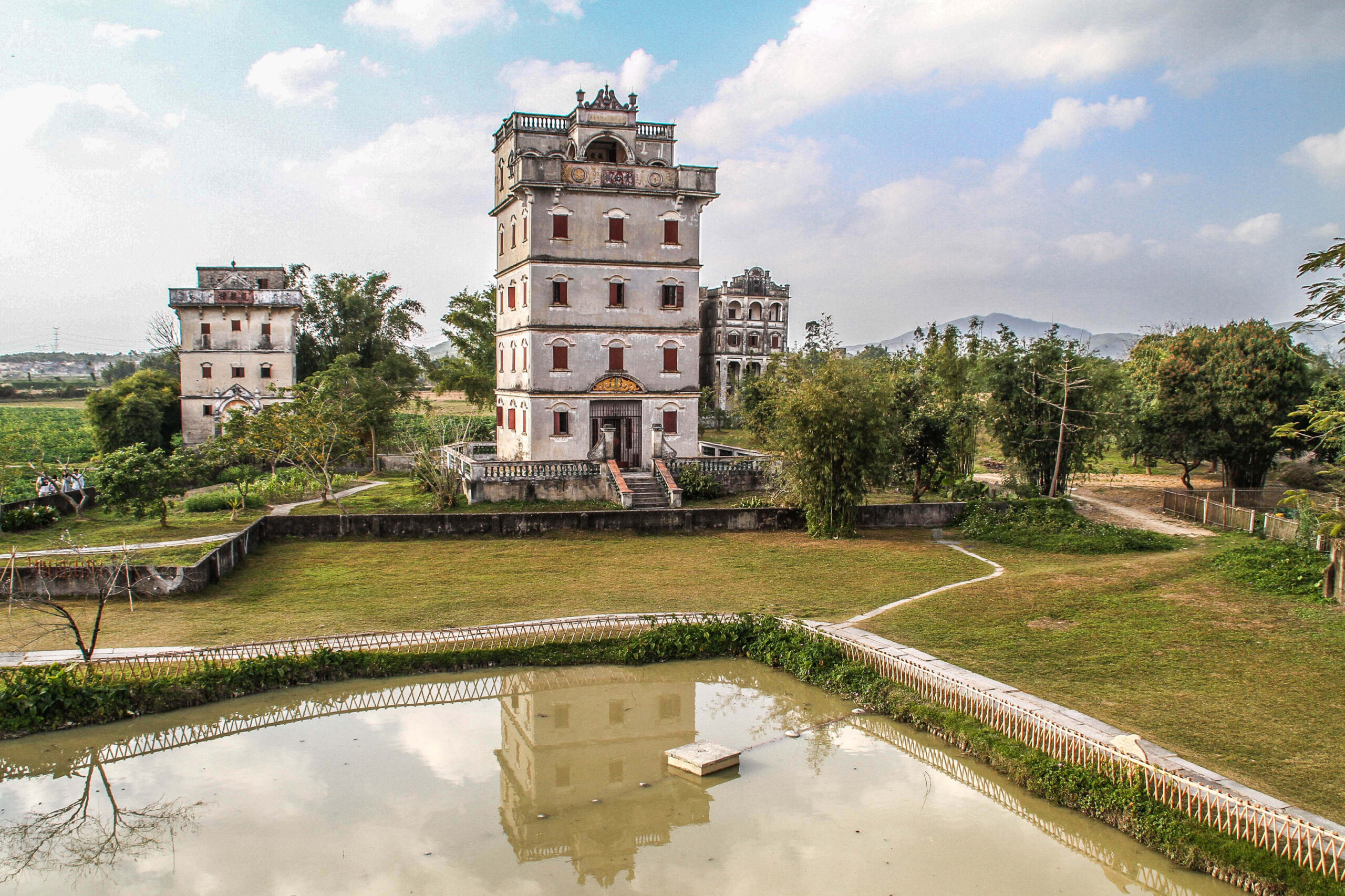
The diaolou are one of the most spectacular and eclectic architectural examples of the fusion between Chinese and Western culture. These bizarre buildings are multi-story, fortified towers and are scattered in the countryside around the city of Kaiping, two hours from the center of Guangzhou in the extreme south of China.
The first diaolou were built around the 17th century for the purpose of defending the people of the countryside from frequent bandit assaults. The typology reached its peak splendor and popularity a few centuries later between 1920s and 1930s. In that time the dialou numbered over 3,000.
Today there are about 1,800 diaolou towers still standing in the Cantonese countryside. Some are in a state of neglect, while others are still inhabited. Some of the richest and most majestic clusters were declared a World Heritage Site in 2007 and are currently inscribed in the register of UNESCO sites.

The Diaolou of Kaiping: a unique architectural fusion between China and the West
The diaolou are one of the most spectacular and eclectic architectural examples of the fusion between Chinese and Western culture. These bizarre buildings are multi-story, fortified towers and are scattered in the countryside around the city of Kaiping, two hours from the center of Guangzhou in the extreme south of China.
The first diaolou were built around the 17th century for the purpose of defending the people of the countryside from frequent bandit assaults. The typology reached its peak splendor and popularity a few centuries later between 1920s and 1930s. In that time the dialou numbered over 3,000.
Today there are about 1,800 diaolou towers still standing in the Cantonese countryside. Some are in a state of neglect, while others are still inhabited. Some of the richest and most majestic clusters were declared a World Heritage Site in 2007 and are currently inscribed in the register of UNESCO sites.
There are 3 different types of diaolou:
– communal towers built by several families together to be used as temporary refuges in case of bandit attacks
– watchtowers
– fortified residential towers used as residences
The materials of diaolou are stone, brick, compressed earth, and for the newer buildings, reinforced concrete (a rarity at the time in this area of southern China). Each diaolou tower is unique, but the typology contains some common elements. These are the small openings for doors and windows, and the watchtowers at the highest part of the building, that guarantees a 360 degree view of the surrounding area. The decorative elements, more or less eclectic and showy, were used to display the wealth and well-being of the owners.


You can see diaolou towers scattered throughout the countryside or embedded in Kaiping city simply by pedaling through the county. The most majestic and well preserved diaolou though, are found in some specific clusters, which can be visited by purchasing a single ticket (price varies by cluster) or a cumulative 2 day ticket which grants entry to the most famous sites: Zilicun, Jinjiangli and Majianglong Diaolou Clusters, Liyuan Garden, and The South diaolou in Sanmenli Village.
Visiting the most beautiful Kaiping Diaolou, UNESCO World Heritage Sites
ZILI VILLAGE (自力 村)
The Zili Village (Zilicun) of Tangkou township (塘 口镇) is composed of 15 diaolou scattered through rice fields and is the biggest cluster. Only three of the towers are open to the public, but an ascent to the top floors grants visitors a wonderful view of the surrounding countryside.
Zilicun was the first cluster I visited and I returned to Kaiping around 4pm just in time to enjoy the surreal scene before the sites closed. Despite being a famous site, there were only a few visitors (the time of my visit was the week before Chinese New Year, an optimal period for sightseeing as many people spend their time at home with their family and touristy places are considerably less crowded).


JINGJIANGLI VILLAGE (锦江 里)
Behind the small village of Jinjiangli, located in the Xiangang township (蚬 冈 镇) stands the tallest and most impressive diaolou, the Ruishi Lou (瑞石樓). It is an eclectic and colorful 9 story tower characterized by a mix of Byzantine and Neoclassical elements. I visited this incredible place on Chinese New Year’s Eve and I was the only visitor (even the ticket office was closed, and the tower was unfortunately not accessible internally for this reason)


A few hundred meters from Jinjiangli and well worth a visit is the small village of Nanxing (南 兴村), where the Nanxing Xie Lu, the ‘Leaning Tower’ stands. The diverse mix of facades on the houses overlooking the pond in front of the village offer a very picturesque view. It was worth a visit just to experience the life of the residence as they prepared for the Chinese New Year.


MAJIANLONG CLUSTER (马 降龙)
Considered (according to local brochures) the most beautiful of the villages, Majianlong (马 降龙) of Baihe township (百合 镇) rises above the countryside, surrounded by bamboo forests and banana trees. The village is bigger than the other clusters and divided into 3 parts. The diaolou seem more like sumptuous villas than watch towers, nestled in the back of the village, immersed in lush vegetation. At the front, the traditional one-story fortified dwellings open along the narrow transversal streets, giving the village a closed and extremely compact appearance. At the time of my visit the locals were immersed in preparations for the New Year, plucking chickens outside the entrance doors and lighting red firecrackers.
Once again I was the only visitor (besides me there was only my driver waiting at the empty parking lot in front of the village). It was amazing to forgo the crowd and have the place just for myself! On the other hand, the main sites where closed so I couldn’t enter inside the most beautiful buildings, which I would have really enjoyed.


SANMENLI VILLAGE (三门里)
The Yinglong Lou (迎龙楼) is located in Sanmenli village of Chikan township (赤坎 镇). It boasts the title of the oldest tower in the area, built in the middle of the XVI century.
To the south of Sanmenli lies the “Canada Village” (加拿大村), which was established in the 20s by overseas Chinese that returned from Canada.
Both these places have been declared as part of the Kaiping Diaolou Unesco Site.
Sanmenli is located near the town of Chikan (赤坎), which is famous for its loggias opening on the riverside. It is officially designated a Historic and Cultural Town of China because of its importance as a market town, maritime hub, and emigrant center.

Inspired by picturesque photographs of building facades I saw on the internet and in tourist brochures, I decided to make a detour to an ancient shopping street along the canal. Unfortunately, at the time of my visit this site appeared totally abandoned, dirty, and no longer used. I read later that an intensive reconstruction plan was formulated in 2017, which will last several years.
Is it worth to visit the Kaiping Diaolou? My opinion
As a traditional architecture nerd, I found the Kaiping Diaolou fascinating, and almost surreal. The architecture with the combination of styles in this particular typology is something special and unique which cannot be found anywhere else in China or the World.
Even though it is listed as an Unesco Site, it is still extremely underrated and doesn’t garner a lot of attention or attract much tourism (almost only Chinese locals). The regional tourism enterprises are working to make the Kaiping Diaolou more renowned, nationally and internationally. I think this place deserve more recognition, but the fact that it is not famous makes it much more enjoyable to visit, because Chinese tourist attractions can get insanely crowded once they become tourism epicenters.
I spent only a day and a half (enough to take it easy if you rent a driver), but the whole trip can be squeezed into one day from Guangzhou if renting a car. It was early February on Chinese New Year’s Eve, which made my visit very enjoyable because it was free of crowds, but slightly more difficult due to the lack of functioning hotels, available services, and lack of bus connections between Guangzhou and Kaiping (due to upcoming celebrations the bus rides between the two cities stopped at noon).
If you are taking a trip around Guangzhou or Shenzhen and you are into architecture, I highly recommend visiting this place. Not only does it hold cultural importance, but it is one of those places that make you think: “Which kind of crazy building am I looking at???”
This is truly the first thought that came to my mind in this beautiful, yet bizarre place.

Leave a Reply