
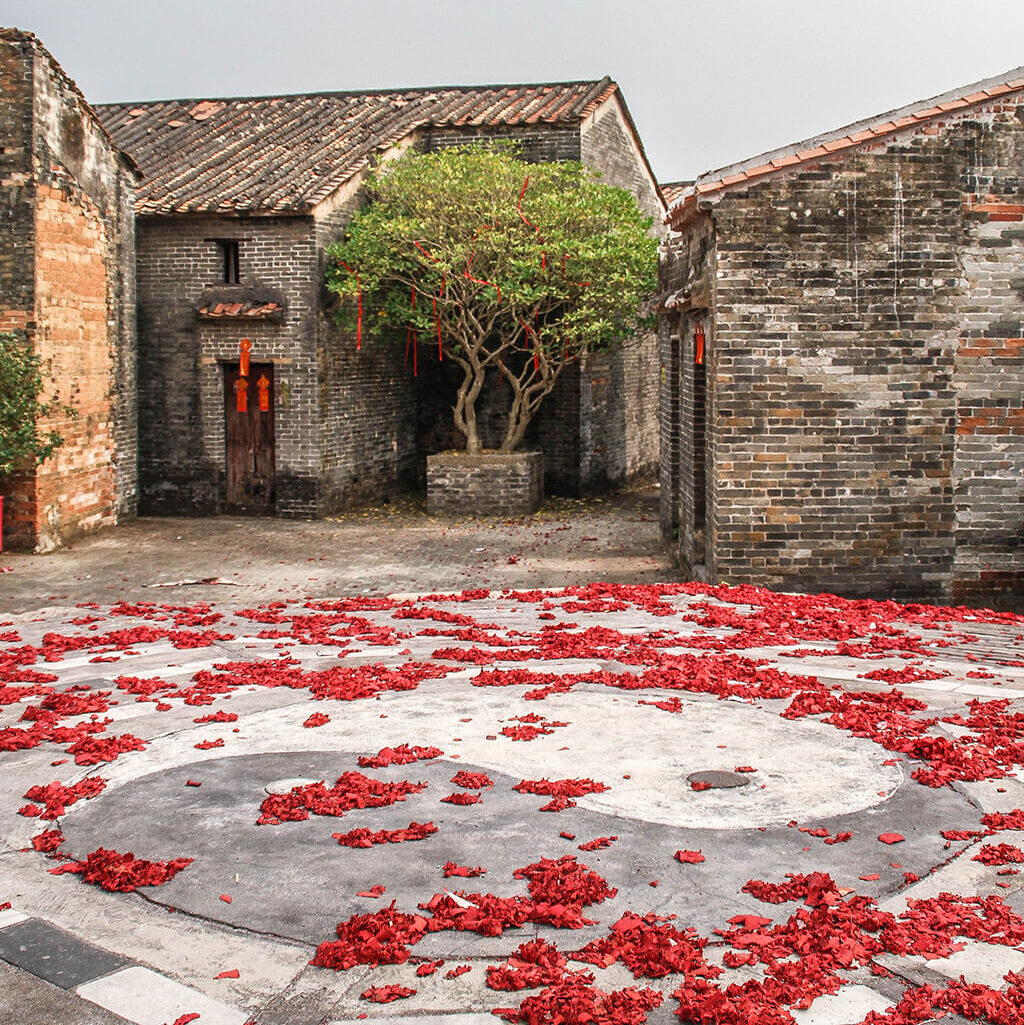
The Chinese village of Licha Bagua (黎 槎 八卦 村 – Lí chá Bāguà cūn) is a fascinatingly unique place. It is the perfect example of a Bagua village, a special category of the vernacular architecture of southern China.
Located a few kilometers from the city of Zhaoqing, Licha Bagua is just 2 hours by train from Guangzhou. The village was built almost 800 years ago and is surrounded by water.

What is a “bagua” village?
A Bagua village (八卦 村, or ‘eight trigram village’) is designed to reflect the philosophy of Taoism.
The shape of the plan is characterized by an octagonal shape, which holds special meaning in the Taoist doctrine where the octagon has symbolic value.
The special configuration of the octagon is formed by eight trigrams that represent the five elements.
These representative trigrams form the foundation of the Taoism discipline and can also be found in the fengshui theory.
THE EIGHTH TRIGRAMS OF TAOISM
Trigrams represent the five elements of Taoism: Water, Wood, Fire, Earth and Metal. According to Taoism and fengshui these five elements influence human life, externally through the climate and environment, and internally through the chemical processes of the human body.
The lines that make up the trigrams can be whole with the positive polarity of Yang, or broken with the negative polarity of Yin.
Each trigram contains three of these lines, assembled in 8 different combinations. The combination of the 8 trigrams/elements form 64 hexagrams.
These 64 hexagrams are the basis of the I-Ching (the classic ancient Chinese divination book), and represent all the possible conditions of human life.
THE FENGSHUI
Multitudes of books have been written on the doctrine of fengshui. In this article I will limit my explanation to the basic concepts of fengshui so the casual reader can understand and appreciate the implications this influential discipline has in Chinese culture.
The doctrine / philosophy / pseudoscience of fengshui literally translates to wind (feng) and water (shui). In the west it is known as Chinese Geomancy. The fundamental element of fengshui is Qi (氣), which can be translated as ‘energy‘ or ‘life force’. The natural and uninterrupted flow of Qi ensures good health (physical and mental), and good luck (in private life and in business). The flow of Qi must be facilitated both in the body (as one of the main foundation of traditional Chinese medicine) and in space.
For this reason Chinese architecture often follows a specific ruleset, regarding everything from the foundation of cities to the arrangement of furniture and interior spaces of houses. Everything must be positioned to facilitate the flow of this vital energy, which will reflect positively in the lives of the inhabitants. A bad or disjointed arrangement can cause a blockage of qi and create ‘bad fengshui’, which is reflected in poor health and bad luck.
Through history, Fengshui has always had a potent impact on the urban planning of villages and cities, and also in the layouts and aesthetics of homes and gardens.
Just think that the capital city of Beijing itself has fundamental characteristics that adhere to the principles of fengshui. Even today in modern Chinese architectural studios it is sometime required to consult a fengshui master in order to get the project approved.
…. but let’s go back to the bagua villages!
The foundation plan of Bagua villages (bāguà cūn) is based on the eight trigrams, which form the Bagua Map.
八卦 bāguà: eight trigrams
村 cūn: village

There are two versions of the Bagua map. The first map is used for cemeteries and tombs, the second for houses. The difference lies in the position of the trigrams, which alters the various zones of influence.

Exploring Licha Bagua village
At the center of Licha Bagua there is the symbol of Taiji (the taoist ying and yang) inscribed in a circular stone platform. The streets branch off from the center of the village in a radial and concentric pattern, making the plan a real labyrinth. In the two hours I spent in this village I often found myself in the same place, without doing it on purpose, and with no knowledge of how I got there.

In the central part of the village you can admire the ‘wok handle’ shaped roofs of the houses, a distinguishing characteristic of the regional architecture, which symbolizes the wealth of families. Between the houses are many altars, adorned with fortuitous symbols and food offerings.

The village is basically a ghost town. I found only a couple of houses that seemed to be inhabited, but most of the dilapidated buildings are abandoned. However, it is still frequented by some of its old residents, many of whom have moved into modern houses that were built around the village and across the river.
I was the only tourist during my visit to the village, which allowed me to really appreciate the local atmosphere. There were few local inhabitants bringing food offerings to the altars, exploding red firecrackers (it was the Chinese New Year week), lighting incense and attaching lucky red banners to the houses of the ancestors. The scene presented to me was a little eerie. Completely ruined houses with collapsed roofs, alleyways and deserted streets, all abandoned for years; now with smoke rising from recently lit incense sticks at the rusty doors of houses, fresh fruit on altars, and the feeling that someone was right there a moment ago. It was surreal and a bit disquieting!


I read that only one elderly couple still resides in the village. While walking in the central square, an elderly lady repeatedly asked me to buy red firecrackers. Perhaps she is one of the last remaining inhabitants?


Why Licha Bagua is worth a visit
This village represents a unique typology, which embodies the vernacular tradition of southern China and its philosophical doctrine. It was incredible to see how this place reflected the rules and beliefs of Taoism with its aim to live in balanced harmony. Among all the Bagua villages which still exist, only a handful are publicly known and considered of interest.
Although it has been largely abandoned by its residents who have moved into practical modern houses (looks like would be extremely expensive, if not practically impossible to make the old dwellings conform to modern standards of living), Licha Bagua remains intact with its original conformation. It is a lesser known destination and not the subject of mass tourism. Licha Bagua has retained its original, 800 year old features and avoided being transformed into a theme park full of souvenir shops. And I hope this will never happen, as it will lose all of its authenticity and charm.

Leave a Reply