
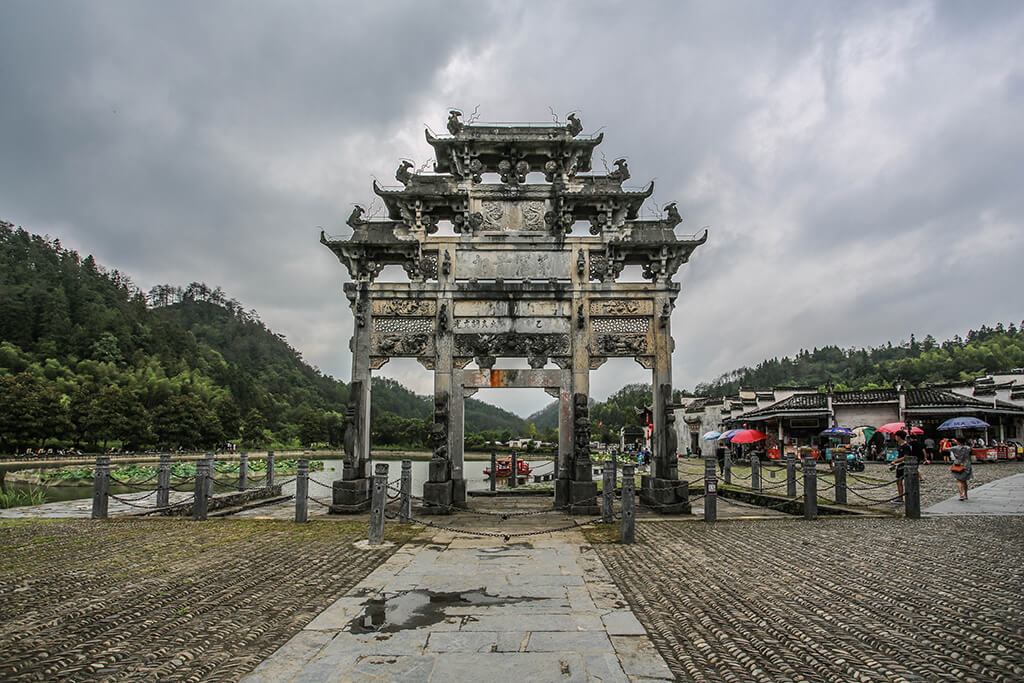
About 40 km from the city of Huangshan in Anhui Province of China, the picturesque village of Xidi (西递镇) has a rich history spanning over 900 years.
This ancient village is one of the most famous spots of Huzhou region; his perfect conservation through centuries and his cultural value worth Xidi – together with the village of Hongcun – the title of UNESCO World Heritage Site from the year 2000.
The narrow paved alleys, the tall white walls, the adorned gates and the intricately carved wooden interiors make Xidi a perfect example of Hui Architecture.

Located in the countryside between green hills and streams, it is one of the favorite destinations of many art students who come to this village to portray the picturesque alleys and views, and destination of thousands of tourists that every year come in Anhui Province to admire one of the best preserved vernacular architecture of the whole China.
Founded initially during the Northern Song Dynasty (960-1127) for centuries Xidi has been home to many rich merchants. Among them, the Hu family was initially the main contributor to the construction of magnificent residences and public buildings, which have earned today the village the title of UNESCO World Heritage Site.
There are many authentic Ming and Qing dynasty houses which can be admired simply wandering around. Some of them became museums because of their special historic an architectural quality, and can be visited inside.


Today the main source o income of the village is tourism; because of that many inhabitants turned their buisiness into the servic industry, hosting in their homes little hotels, restaurants or souvenirs shops with local products and antiqueries.


The most significant landmark of Xidi is the decorative arch placed at the entrance of the village, built during the Ming dynasty in memory of the Officer Hu Wenguang.
A funny anecdote: 80% of the inhabitants share the same surname (‘Hu’).
To access the village is required to purchase a ticket entrance


Leave a Reply